
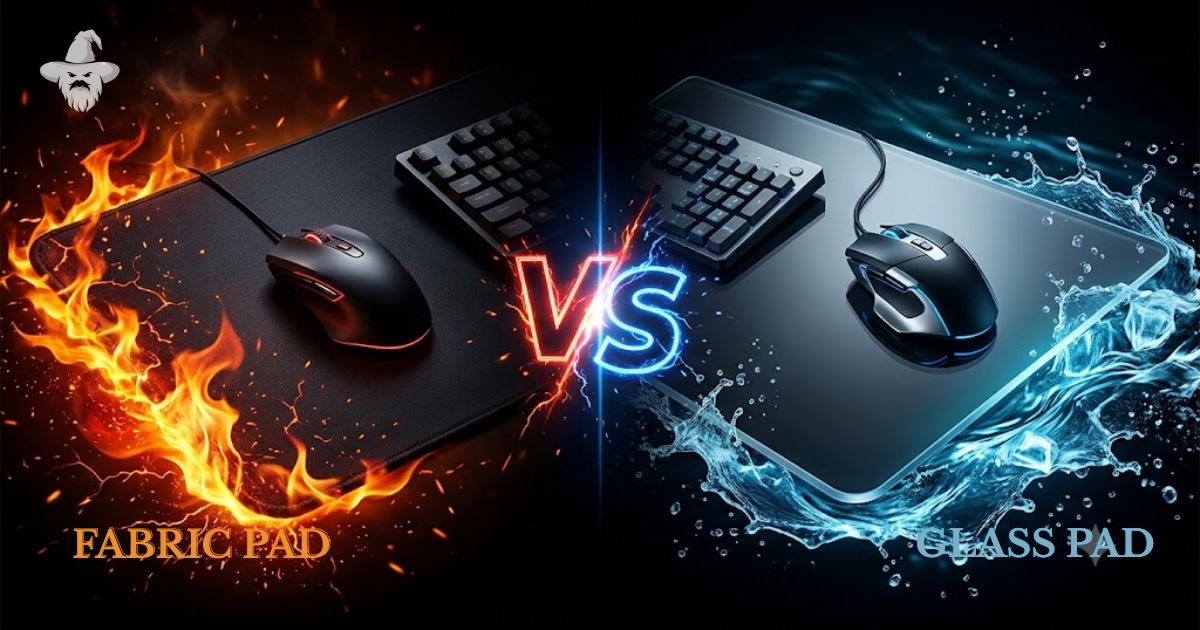
You’ve bought a good mouse and a fast monitor. Is the game still not working the way you want it to? The problem might lie on your desk. A high-quality mouse pad is essential for accuracy in esports games.
For years, fabric mouse pads dominated the market. Nowadays, synthetic mouse pads are becoming increasingly popular. How do they differ? Which one should you choose for your favorite games? Let’s analyze the pros and cons of both options.
When we think about gaming, most of our attention goes to graphics, high-refresh-rate monitors, or an esports mouse. But even the best optical sensor in the world won’t perform at its best if paired with a poor-quality, worn-out surface.
Choosing the right mouse pad is a never-ending topic. For years, the market was dominated by classic fabric mouse pads. However, a technological revolution has brought about the rise of ultra-fast glass mouse pads. How do these two worlds differ? Why invest in expensive glass, and how does the type of surface affect your accuracy in games? Let’s take a closer look at both solutions, analyzing their pros, cons, and intended uses.
1. Two Key Concepts: Speed vs. Control
Before we move on to the gear, you need to understand two terms used by professional gamers and hardware reviewers:
Static Friction: The force you must overcome to get the mouse moving. The lower the static friction, the easier it is to make micro-adjustments to your aim.
Dynamic Friction: The resistance you feel once the mouse is already in motion. Higher dynamic friction makes it easier to “lock” your crosshairs onto an opponent’s head.
Tip: Mouse pads are divided into Speed (very fast, low friction) and Control (slower, providing great control and stopping power).
2. Cloth Pads
The classic standard. Cloth pads are most often made of densely woven fabric (e.g., polyester or nylon) mounted on a rubber, non-slip base.
Comparison of fabric and glass coasters:
Pros:
- Amazing control (braking power): Thanks to the natural resistance of the fibers, the fabric stretches only to a specific target area. These are key features in tactical shooters (CS2, Valorant).
- Comfort and warmth: The material is soft, gentle on your wrists, and keeps your hands warm on winter nights.
- Portability: You can easily roll it up, toss it in your backpack, and take it to a tournament or to a friend’s house.
- Price: You can buy this high-quality material for just a few zlotys.
Cons:
- Lack of Moisture Absorption (Mud Pad Effect): The fabric absorbs sweat from your hands and moisture from the air. On rainy days, the pad becomes sluggish and starts to resemble “mud,” which drastically changes the mouse’s performance.
- Rapid Wear: The fibers wear out where you use it most often. After a few hours of wireless gaming, the center of the mouse pad is more worn than the edges.
- Difficult to Clean: It collects dust, dead skin, and pet hair. It requires regular, thorough washing.
3. Glass Pads
A new era in gaming: Made of special tempered glass that provides a perfectly smooth and uniform surface.
Pros:
- Extreme speed and zero friction: The mouse glides across the glass as if on ice. Static friction is virtually nonexistent, and making micro-adjustments to your aim requires no effort at all.
- Indestructibility: Glass doesn’t wear out. You buy a single glass mouse pad, and as long as you don’t break it, it will retain the same properties for a decade.
- Weather resistance: Glass doesn’t absorb moisture or sweat. Movement remains just as smooth in the sweltering summer heat as in the freezing winter cold.
- Effortless cleaning: Just wipe it down with window cleaner and a microfiber cloth. In 10 seconds, the mouse pad is like new.
Cons:
- Unforgiving of mistakes (no braking force): Since glass offers no resistance, stopping the crosshairs depends 100% on your muscle strength. If you have a shaky hand, your crosshairs will “overshoot” the enemy model.
- Rapid wear on mouse feet: The glass surface acts like a fine grater. Classic Teflon mouse feet wear down on it in no time (often needing replacement every 1–2 months). The solution is to use glass or sapphire mouse feet.
- Discomfort and noise: Glass is hard and cold. Every grain of sand under the mouse generates a terrible scraping sound. Additionally, gamers often have to wear special esports sleeves (gaming sleeves) to prevent their forearm skin from “sticking” to the glass.
4. A Quick Summary:
| Feature / Game | Cloth Mousepad | Glass Mousepad |
| Best for games: | CS2, Valorant, Rainbow Six Siege (focuses on holding precision crosshair placement in one spot) | Apex Legends, Overwatch 2, Warzone, Quake (focuses on continuous, smooth tracking behind a moving target) |
| Durability: | Low (replace every 6–12 months) | Extremely High (lasts for years) |
| Maintenance: | Hand wash, long drying time | Wipe with glass cleaner in 5 seconds |
| Impact on mouse skates: | Minimal | Very High (wears down PTFE skates quickly) |
5. Personal Choice: What Exactly Matters to You?
There’s no one-size-fits-all mouse pad that’s perfect for everyone and every game. The final choice comes down to answering this question: What are your personal habits, and what makes you feel more confident?
A. Habits of Cleaning and Caring for Your Gear
- If you don’t like wasting time: A glass mousepad is an absolute winner. If you spill a drink or the mousepad gets dusty, all it takes is 10 seconds, some glass cleaner, and a microfiber cloth. It’ll be like new.
- If you don’t mind doing laundry: Fabric requires patience. To maintain its properties, you’ll need to wash it once in a while in a bathtub or basin with mild detergent, then wait a few hours for it to dry.
B. Playstyle vs. Market Myths (Glass in CS2?)
Many players repeat the common myth that “only fabric is suitable for CS2, while glass is only good for games like Apex or Overwatch.” The reality on the esports scene and in higher ranks shows something completely different:
- Why would some players prefer glass in CS2 or Valorant? Players with excellent hand control and great muscle memory can gain an incredible advantage from glass. Zero static friction allows for lightning-fast, almost microsurgical aim adjustments down to the level of individual pixels. If you can perfectly stop your hand on your own (without resistance from the mouse pad), glass will give you unmatched reaction speed.
- Why do others choose fabric in games that require fast tracking? In games like Warzone or Apex Legends, where glass theoretically reigns supreme, some players prefer fabric mouse pads (especially Hybrid or Speed types). These give them a greater sense of “feel” for the surface, which prevents hand fatigue during long sessions of constantly chasing a fleeing enemy.It all comes down to whether the space beneath your mouse should actively assist you in slowing down, or whether it should offer no resistance at all, leaving full control to your hand.
What should you choose?
Choose a fabric mouse pad if: You’re looking for a soft, warm surface; you value the mouse’s natural braking force; you have a more modest budget; and you don’t mind having to replace it with a new one in a year or two.
Choose a glass mouse pad if: You’re looking for a purchase that will last “for years,” you hate the sticky feeling and the slower center of the pad on hot days, you like a perfectly smooth glide without any resistance, and you’re prepared to replace the Teflon glide pads in your mouse more frequently.
6. FAQ (Quick Answers)
Does a glass mouse pad damage the mouse?
A glass mouse pad does not damage the mouse itself or its sensor, but it drastically accelerates the wear and tear on its glide pads. When using a glass mouse pad, you should expect to replace the glide pads regularly or invest in glide pads made of tempered glass or ceramic.
Which mouse pad is better for CS2—glass or fabric?
For games like CS2 or Valorant, most professionals recommend fabric mouse pads. They provide higher dynamic friction, which makes it easier to precisely stop the crosshair on an opponent’s head (so-called “stopping power”) and maintain stable recoil control.
Do you need to use a sleeve with a glass mouse pad?
Most players who use glass mouse pads opt to play with a special sports or gaming sleeve. Since glass doesn’t absorb moisture, sweaty or even slightly damp skin on the forearm can “stick” uncomfortably to the surface of the mouse pad, which disrupts the fluidity of movements.

SmoothWizard